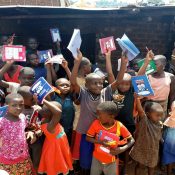
A Crisis Hidden in Plain Sight
Every morning, across the slum zones of Kampala in Kazo, Namuwongo, Banda, Kinawataka, Ggaba, and beyond thousands of children wake up with a choice that should not exist: stay home, or find a way to school with nothing to write on and nothing to write with.
This is not a story about reluctance. These are children who want to learn. Who sit at the edge of school yards and watch their peers receive lessons they cannot access not because of a lack of intelligence, or a lack of ambition, but because they do not own a notebook. They do not have a pen.
“Imagine a child eager to learn, full of curiosity and potential but unable to attend school simply because they lack a notebook or a pen. For many children in slum communities, this is their daily reality.”
In Uganda’s informal settlements, the gap between a child and an education is often measured not in miles or years, but in the small, tangible things that most families take for granted. A school bag. An exercise book. A pencil. The uniform that lets a child blend in rather than stand out in shame.
The consequences of this deprivation extend far beyond missed lessons. When a child cannot participate in class, they begin to believe they are not meant to be there. Dignity erodes. Confidence collapses. And the cycle of poverty already entrenched across generations in Uganda’s slum communities, tightens its grip.
Where Slum Life Survival Was Born
Slum Life Survival (SLS) did not emerge from a boardroom or a policy paper. It was born from lived experience from the ground, from within the slums themselves, and from a conviction that community-led action could do what institutions had failed to do.
In 2018, Kavulu Kenneth who would become SLS’s Executive Director was awarded the prestigious Ton Schaten WASH Award for his outstanding journalistic reporting on water, sanitation, and hygiene in Kampala’s slums, conducted through the BBS TV program “Embeera Y’omugotteko” (Life in the Slums). Through that work, he did not just report on hardship. He witnessed it, named it, and refused to walk away from it.
It was through its mission – To improve livelihoods through skills training, education, and development, the provision of basic necessities, and encouraging social cohesion that the need to support school going children in the slums is derived.
Today, SLS operates across seven interconnected focus areas: Education, Health, Economic Empowerment, WASH, Child Protection, Gender and Women Empowerment, and Sports and Talent Development. Education has always been, and remains, one of the most urgent pillars of that work.
What Scholastic Support Actually Means
Ask any teacher in a slum-area school what keeps children away from learning, and they will not describe a lack of ambition. They will describe empty desks on Mondays when school fees were due. They will describe children who share a single pen among five classmates. They will describe the quiet humiliation of arriving without the materials that signal you belong.
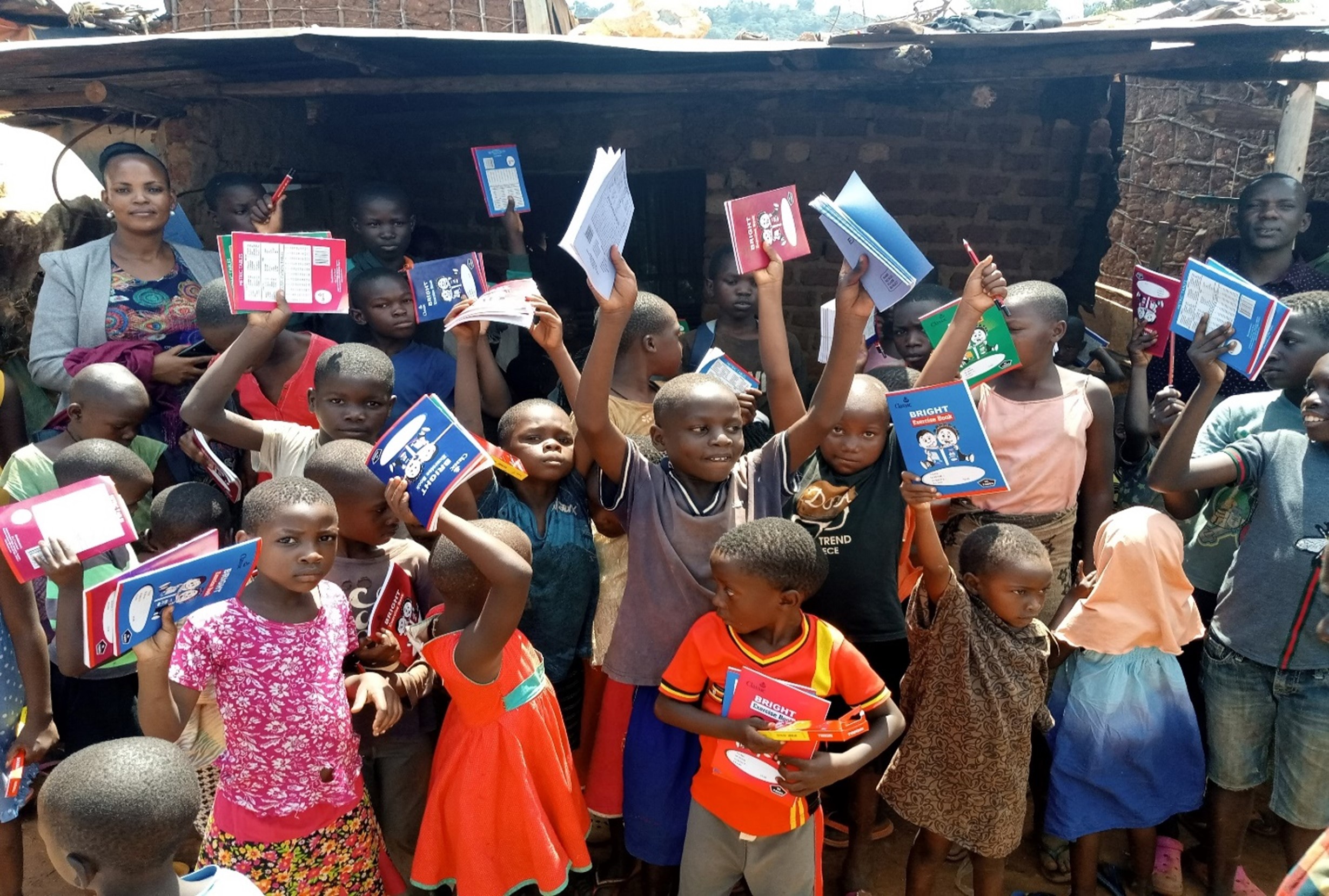
SLS’s scholastic materials support program addresses this reality directly and practically. Through partnerships with community leaders, parent networks, and school administrators, SLS identifies the most vulnerable children — those at highest risk of dropping out, those in households where every shilling goes toward food, rent and provides them with the basic tools of learning:
- Exercise books and writing materials
- School bags and geometry sets
- Pens, pencils, and rulers
- Supplementary reading materials
The effect is immediate. A child who arrives at school with a full school bag does not just have supplies. They have a signal — to themselves, to their teachers, to their peers — that they are there to stay. That they belong.
“This simple act restores confidence, dignity, and the joy of learning. Behind every school kit is a child who now has a chance — a chance to learn, to grow, and to rewrite their story.”
To date, SLS has supported over 2,000 children with scholastic materials, enabling them to attend school consistently, participate actively, and believe in their ability to succeed. The target under the current five-year plan (2025–2030) is to support 100 students per year through direct scholastic material distribution, as part of a broader vision to reach 1,500 children annually through combined scholarship and materials programming.
Scholastic materials are the entry point. But SLS understands that education is a system — and that fixing one broken part without addressing the whole is not enough. That is why SLS’s education programming is built in layers, each reinforcing the other.
Early Childhood Development (ECD)
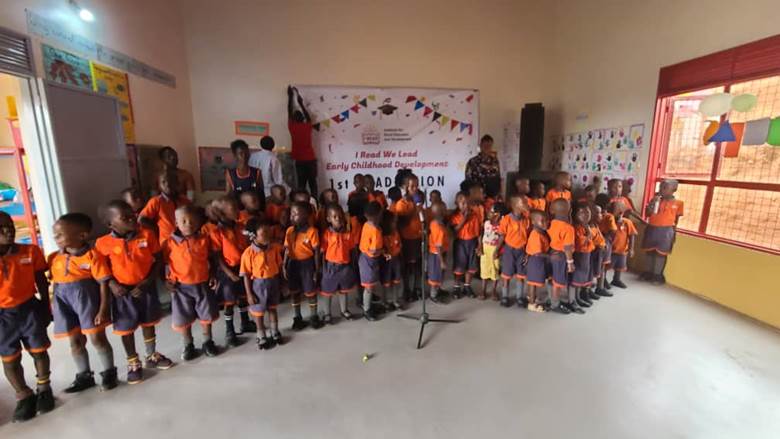
At the foundation is the IREAD ECD Centre in Kazo — an early childhood program that gives slum-based children their first structured experience of learning. In communities where preschool attendance is a luxury most families cannot afford, SLS’s ECD programme plants the seed of literacy, numeracy, and social development before formal school even begins.
The five-year plan commits to expanding the ECD programme to cover Primary 1 through Primary 7, building a complete and uninterrupted learning pathway from a child’s earliest years through to upper primary completion.
Scholarship and Education Support
For children already in school, financial barriers remain the most consistent reason for dropout. SLS’s scholarship programme addresses school fees, examination costs, and material needs for the most vulnerable learners — particularly adolescent girls, children from female-headed households, and children with disabilities.
Closely linked is the Bridging the Gap Programme: a targeted intervention for adolescent girls at risk of dropping out, combining scholarships with mental health support, counseling, and gender-responsive training for teachers and parents. For girls who have already left school, the programme offers vocational and life skills training as an alternative pathway.
The Child Behind Every School Kit
It would be easy to talk about education in the abstract, in policy frameworks, in sustainable development goals, in enrolment statistics. But the work of SLS is never abstract. It is always personal.
It is the child in Namuwongo who missed three weeks of school because she had no uniform and did not want to be sent away from the classroom. It is the boy in Kinawataka who borrowed pens so many times that his teacher stopped calling on him, assuming his silence was indifference. It is the girl in Kazo who walked past the school gate every morning without going in, not because she did not want to, but because she had nothing to carry.
“No child should miss school because of something so basic. Partner with Slum Life Survival by donating scholastic materials, sponsoring school kits, or supporting our education initiatives. Together, we can remove barriers, uplift dreams, and ensure every child has the tools they need to succeed.”
SLS’s education work is built on a simple conviction: that every child in the slums has the same potential as every child anywhere else. What they lack is not intelligence or determination — they lack the basic infrastructure of learning that more fortunate children receive as a matter of course. When SLS closes that gap, even partially, the results are visible. Children attend more consistently. They participate more actively. They begin to see themselves as learners.
That is the transformation that begins with a notebook. That is why this work matters.
Partner With Us
SLS invites individuals, organizations, businesses, and government bodies to join in this work. Every child in a Kampala slum who goes to school with a full bag represents a small but real victory over poverty. Multiply that by thousands — and you have a generation.
There are several ways to partner with Slum Life Survival:
- Donate scholastic materials directly — books, pens, bags, and geometry sets
- Sponsor a school kit for a child for an entire academic year
- Support the 1,000 UGX Campaign with a contribution in any amount
- Fund a scholarship for a vulnerable child or adolescent girl
- Support the expansion of the IREAD ECD Centre to full primary
Contact SLS: info@slumlifesurvivalug.org | www.slumlifesurvivalug.org